 Contact us
Averiom POC Demonstration
This video shows the full Averiom governance stack running in real time on a physical tool — sensor fusion, prediction kernel, inhibition engine, and cryptographic evidence chain. The POC recorded 182.5ms end-to-end latency, zero false negatives across 15 violation events, and 89.6% tracking uptime with autonomous recovery from occlusion.
SOURCE: HCII2026 · Springer CCIS · “Inverse Constraint Learning for Real-Time Manufacturing Safety” · Tushar Mishra, Averiom (2026)
What you are watching, moment by moment
The demonstration runs the complete governance stack on a physical tool in a laboratory setting. The constraint model was trained on correction events from expert operators. Here is what each stage of the video shows.
The tool moves freely within the learned Negative Manifold. The constraint boundary has been pre-loaded from expert operator correction events. The system runs silently — sensor fusion at 1kHz, Prediction Kernel continuously evaluating trajectory, no inhibition active. The operator has full freedom of motion. This is the baseline: the system is present but invisible.
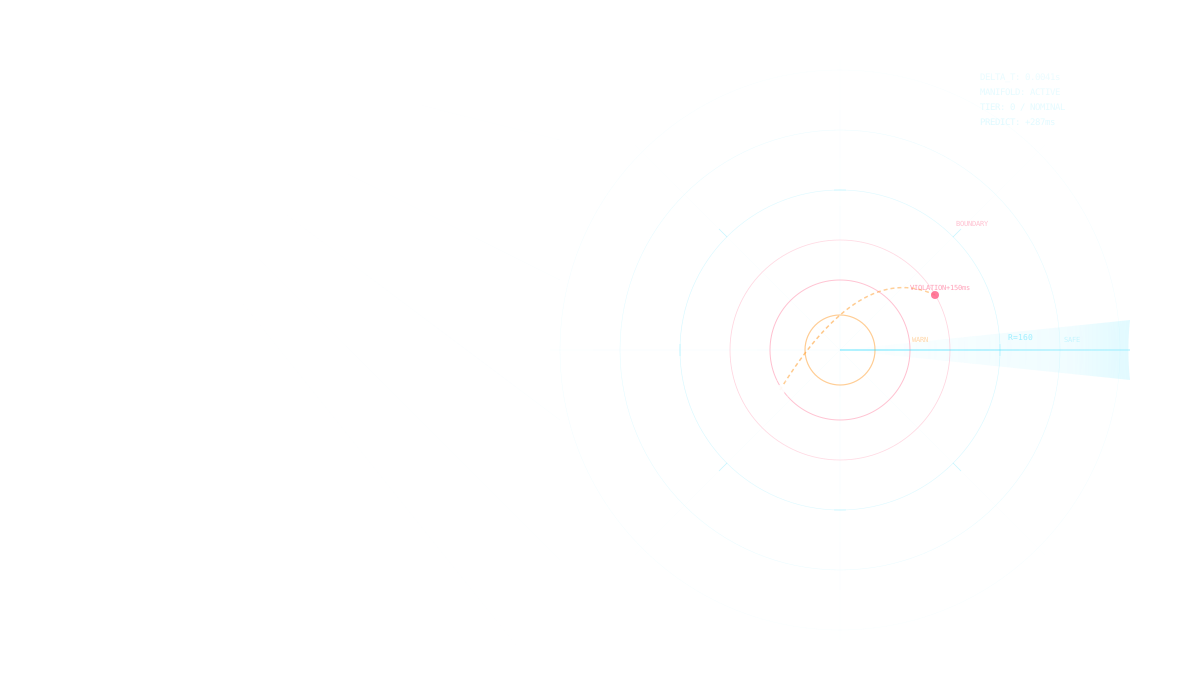
The tool trajectory begins approaching the manifold boundary. The Kalman filter forecasts the path 150–300ms ahead and determines it will intersect the constraint surface. Tier 1 activates: haptic vibration through the tool handle. Most experienced operators self-correct here. The system communicates the risk without interrupting the work. This is governed agency, not automation.
No self-correction after the Tier 1 signal. Tier 2 activates: viscous damping — resistance force that increases proportionally to proximity to the boundary. The tool still moves. The operator is not stopped. The physics of the tool itself communicates urgency. This proportionality is critical — a hard stop at this point would produce workarounds. Graduated response builds trust in the system.
The predicted trajectory will breach the hard constraint limit within 150ms. Tier 3 activates: solenoid hard lock. The tool stops. Total sensing-to-actuation processing time at each stage: under 5ms. The intervention is deterministic and physical — not a software flag waiting on a network round-trip. This is the moment that separates a safety system from a logging system.
The .avm Evidence Chain captures the full event: EVENT_ID (SHA-256 hash), microsecond timestamp, intervention tier, sensor vector at decision time, and predicted violation trajectory. Signed, immutable, tamper-evident. The POC demonstrated complete cryptographically-signable audit trail generation across all 15 violation events. This is not a retrospective log — it is a contemporaneous cryptographic record of the system acting, suitable for post-incident examination, AS 9100 / NADCAP certification workflows, and regulatory audit.
The four-layer governance stack
Vision + IMU + Force fused locally at 1kHz on edge hardware. Detects Correction Events — micro-hesitations and trajectory deviations that precede errors. Zero network hop.
Kalman filter evaluates current trajectory against the pre-loaded Negative Manifold 150–300ms ahead. Acts on where you are going, not where you are.
Tiered physical response: haptic warning → viscous damping → solenoid hard lock. Target sensing-to-actuation loop: under 5ms. Proportional, not binary.
Every intervention SHA-256 signed, timestamped to microseconds, stored in the .avm profile. Tamper-evident. Portable. Survives regulatory and legal examination.
HARDWARE IN THIS DEMO: STM32 microcontroller (real-time kernel) + Nvidia Orin (perception stack). Constraint model trained on expert operator correction events. US Provisional Patent Application No. 63/962,640.
How this architecture applies in the field
The POC runs on a hand tool in a laboratory. The same four-layer stack maps directly to the two beachhead domains we are exploring with Australian industry partners. The physics change. The architecture does not.
Composites Welding & Related Trades
Precision welding and carbon fibre layup on composite structures — aerospace frames, AUKUS submarine manufacturing, structural fabrication — where sub-millimetre control is simultaneously a quality and safety requirement. Manufacturing defect rates of 3–8% in advanced composites operations result in costly rework and constrain critical defence production capacity. Portable .avm profiles encode expert constraint knowledge, preserving workforce IP as skilled operators retire and enabling consistent quality from apprentices operating inside an expert-derived safety envelope from day one.
The boundary approach and tiered resistance you see in the demo is directly analogous to a welder's torch approaching a delamination zone or an out-of-tolerance heat-affected area. The Tier 1 haptic signal corresponds to the subtle instinctive resistance an expert welder self-corrects to — Averiom makes that signal explicit, consistent, and present for every operator on every shift, not only those who have spent 10,000 hours developing the feel.
In a composites deployment, the Negative Manifold encodes the 3D regions of tool position, velocity, and force that expert welders consistently avoid on a specific joint geometry and material specification. The constraint model loads from the .avm profile at job start — it is workpiece-specific, not generic. The Kalman filter predicts torch trajectory 150–300ms ahead against this geometry. At welding travel speeds, sub-millimetre resolution means violations are intercepted before the material registers a defect.
Manufacturing defect rates of 3–8% in advanced composites translate directly to rework cost and schedule impact on programmes where parts cost hundreds of thousands of dollars. The Evidence Chain proves the governance system was active during fabrication, records every micro-intervention, and documents whether any constraint was overridden. For AS 9100, NADCAP, and AUKUS supply chain qualification, this is a verifiable, cryptographically-signed manufacturing process record — the kind of traceability programme managers and quality auditors require but currently cannot obtain from any available system.
Autonomous Mining Equipment
Hydraulic arm control on autonomous and semi-autonomous haul trucks, excavators, and drill rigs operating in Queensland open-cut and underground environments. Boundary violations under multi-tonne hydraulic load carry irreversible consequences — equipment damage, ground instability, serious injury or fatality. Averiom enforces operator constraint knowledge with zero cloud dependency, critical in environments where network connectivity is unreliable or absent.
The Tier 3 solenoid hard lock in the demo is the direct analogue of hydraulic override in a mining arm control system. The scale difference is significant — the demo tool weighs grams, a mining hydraulic arm exerts forces in the tens of tonnes — but the architecture is identical. Predict the violation before it occurs, intervene proportionally, lock if the threshold is crossed. At mining scale the 5ms latency requirement becomes more critical, not less, because the kinetic energy that must be arrested is orders of magnitude greater.
In a mining deployment, the Negative Manifold encodes constraint boundaries for a specific machine operating in a specific zone — bench geometry, load limits, proximity envelopes for other equipment and personnel exclusion zones. Constraint models update as site conditions change. The Prediction Kernel evaluates hydraulic arm trajectory continuously. The Inhibition Engine drives hydraulic pressure override signals rather than a solenoid — the physical actuation mechanism is different, the inhibition architecture is identical.
Under the Queensland Coal Mining Safety and Health Act and WHS legislation, the chain of responsibility places significant liability on operators and OEMs for equipment-related incidents. A post-incident investigation will examine every safety system active at the time. The Averiom Evidence Chain provides a contemporaneous, tamper-evident record of every governance decision — proving active safety management, not passive sensor logging. For insurers, regulators, and coronial inquiries, this distinction is material.
We are seeking design partners to validate this architecture in composites welding and autonomous mining in Australia.
If you operate precision fabrication or autonomous equipment and see the gap between current safety approaches and what the field needs — we want to hear from you. Supported by the Australian Government Industry Growth Programme, in active discussion with AMCN and AMGC.